

PKWY Dental Specialist Practice
9 Scotts Road #12-02 Pacific Plaza
Singapore 228210
| Tel | : | +65 6836 9808 |
| : | services@pkwydental.com.sg |
9 Scotts Road #12-02 Pacific Plaza
Singapore 228210
| Tel | : | +65 6836 9808 |
| : | services@pkwydental.com.sg |
Can Clear Aligners Correct the Same Bite Problems as Braces?
Dr Lawrence Yong
Dental Specialist in Orthodontics (Specialist in Braces)
Braces and clear aligners are both used to move teeth and improve the way the upper and lower teeth meet. This means there can be considerable overlap in the bite problems they are able to correct.
However, having the same type of bite problem does not necessarily mean that braces and clear aligners will be equally suitable in every case. An overbite, underbite or crossbite can vary from one person to another, and the treatment approach depends on more than the name of the problem.
Both braces and clear aligners may be considered for bite correction in a range of orthodontic concerns. Depending on the individual case, these can include:
| Bite Problem | Braces | Clear aligners |
|---|---|---|
| Overbite | May be used | May be used in suitable cases |
| Underbite | May be used | May be used in suitable cases |
| Crossbite | May be used | May be used in suitable cases |
| Open bite | May be used | May be used in suitable cases |
| Crowding or spacing affecting bite | May be used | May be used in suitable cases |
The important distinction is that these labels describe how the teeth or jaws relate to one another, but not necessarily how difficult the problem is to correct.
Two people may both have an overbite, for instance, while requiring very different tooth movements and treatment plans. The more relevant question is therefore whether clear aligners are appropriate for the way that bite problem presents in the individual patient.
Orthodontists look beyond the visible bite when planning treatment. Several factors can change what needs to be corrected and how treatment is approached.
A mild overbite involving mainly the position of the teeth may require a different approach from a more pronounced overbite involving several teeth or differences in the relationship between the upper and lower jaws.
The same principle applies when correcting an overbite or underbite. The diagnosis may sound the same, but the underlying cause and amount of correction required can differ.
Some bite problems are primarily related to tooth position. Others are influenced by how the upper and lower jaws have developed.
Orthodontic appliances can move teeth, but treatment planning may become more complex when jaw position contributes substantially to the bite.
This distinction can affect whether braces, clear aligners or other treatment approaches are suitable.
Correcting a bite often involves more than simply straightening teeth.
Different teeth may need to move in different directions or require more controlled changes in position. The orthodontist will therefore consider how predictable and controllable the required movements are with each appliance.
Once the bite and required tooth movements have been assessed, the orthodontist can consider which appliance may be more suitable for carrying out the treatment plan.
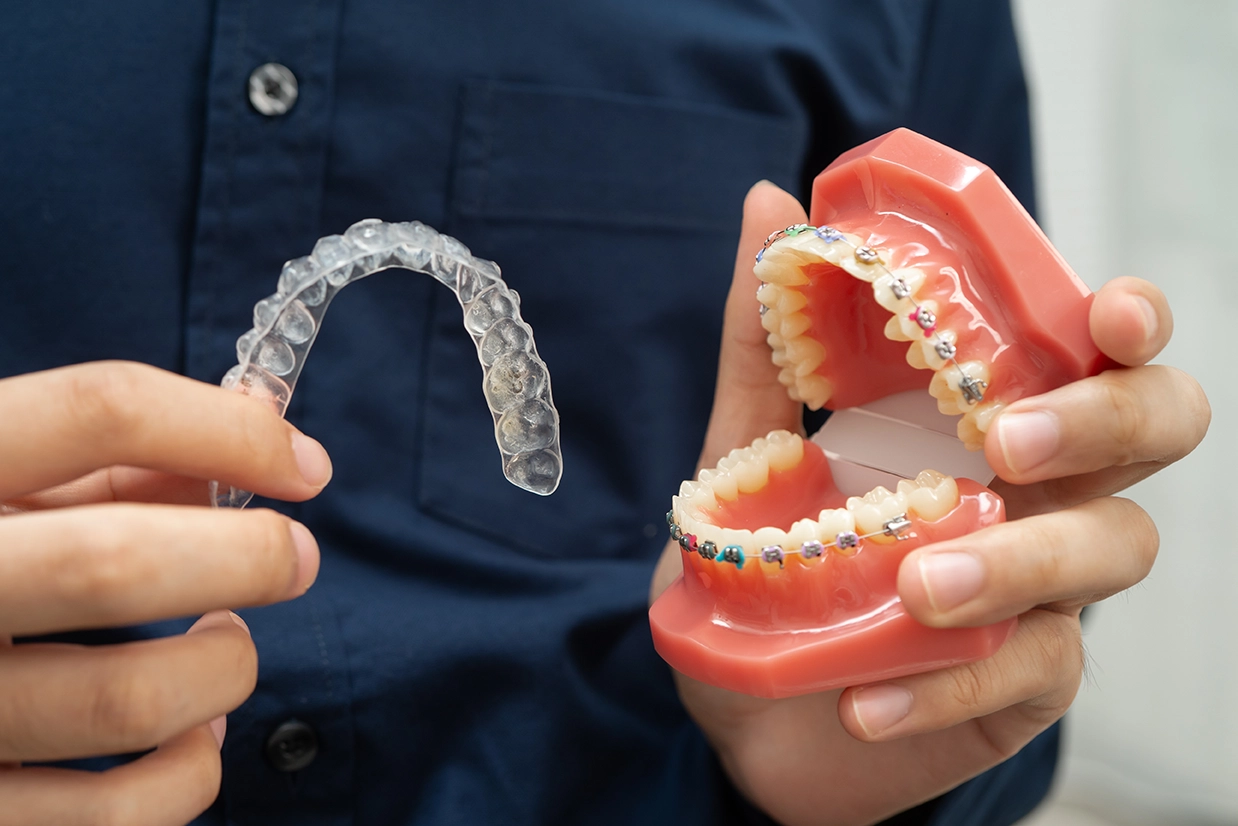
Braces remain fixed to the teeth, so treatment does not depend on the patient remembering to reinsert the appliance. This may be useful where treatment requires more complex or closely controlled movements.
Clear aligner systems, including Invisalign, use a planned series of removable aligners. They may be used to address both tooth alignment and bite relationships in suitable cases, but treatment depends on the aligners being worn consistently as advised.
The orthodontist will also consider the patient’s dental development and ability to follow the treatment routine. Patient preferences can form part of the discussion, but they need to be balanced against what is appropriate for the bite and the movements required.
If you are considering braces or clear aligners for a bite problem, it may not be clear from the way your teeth look which option would be suitable. An orthodontic assessment can help establish what needs to be corrected before the treatment options are discussed.
PKWY Dental Specialist Practice provides orthodontic assessment and treatment for children, teenagers and adults. Dr Lawrence Yong is a Dental Specialist in Orthodontics who provides braces and Invisalign treatment for a range of orthodontic concerns.
To discuss which treatment options may be suitable for your bite, schedule an orthodontic consultation with Dr Yong.
In some circumstances, the treatment approach may be changed if progress or clinical needs make another method more appropriate. Whether this is necessary depends on the individual treatment plan.
In some cases, yes. Some patients have a combination of concerns, such as crowding together with an overbite or crossbite. The orthodontist would typically assess the overall bite rather than treating each issue in isolation.
Not necessarily. Small tooth-coloured attachments may be placed on certain teeth to help the aligners guide particular tooth movements. Their use depends on the movements being planned rather than serving as a simple measure of case complexity.
Bite correction may change the position and relationship of the teeth, which may also influence the appearance of the smile. The extent of any visible change depends on the starting position of the teeth and the treatment objectives.
Dr Lawrence Yong
Dental Specialist in Orthodontics (Specialist in Braces)
Dr Lawrence Yong is an orthodontic specialist with 30+ years of experience treating a wide range of orthodontic conditions in Singapore. His background spans the public, corporate and private sectors, giving him extensive exposure to both routine and complex cases. He is skilled in fixed appliance systems and clear aligner therapy and has been an early adopter of digital orthodontic workflows.
Beyond clinical care, Dr Yong is well regarded for mentoring dentists in the region and has lectured internationally on developments in orthodontics and digital treatment planning. He also previously served as the President of the Singapore Dental Association. Known for his thoughtful approach to treatment planning, he focuses on guiding patients through their orthodontic journey with clear communication and steady, consistent support.


